How to Choose the Right Web Development Company in 2026
By the HoloSolve team · Published · 10 min read
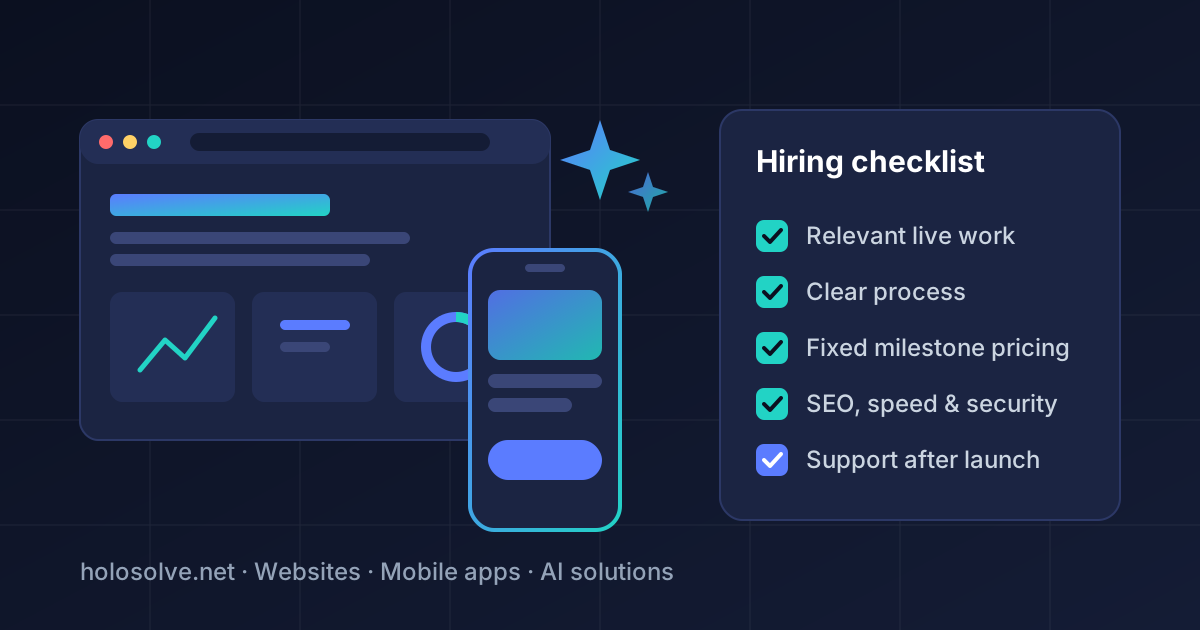
Short answer: the right web development company is one that understands your business goal, shows relevant live work, explains its technical approach in plain language, gives you a written fixed-scope quote with milestones, builds for speed, security and search visibility, lets you own your code and accounts, and supports the product after launch. Price matters, but a cheap build that has to be rebuilt in a year is the most expensive option of all.
This guide turns that answer into a step-by-step checklist you can use whether you need a business website, an e-commerce store, a mobile app or an AI-powered tool — and whether you are hiring a web development company in Pakistan or comparing agencies abroad.
What does a web development company actually do?
"Web development" covers several different kinds of product. Knowing which one you need is the first step, because not every company is strong at all of them:
- Website development: marketing and business websites, landing pages and blogs whose main job is to explain what you do and generate enquiries. Speed, design and SEO-friendly website development matter most here.
- E-commerce development: online stores with product catalogues, carts, payment gateways and order management. An e-commerce website development company should have shipped stores that take real payments.
- Web application development: software that runs in the browser — client portals, dashboards, booking systems, SaaS products. See our custom web application development services.
- Mobile app development: Android and iOS apps, either native or cross-platform. A mobile app development company in Pakistan will often use React Native or Flutter so one codebase serves both platforms.
- AI solutions: chatbots, document processing and workflow automation built into a website or app. A credible AI development company will tell you what AI can and cannot reliably do for your use case.
- Support and maintenance: security updates, hosting, backups, bug fixes and small improvements after launch.
Step 1: Define your goals and scope before you contact anyone
Companies can only quote accurately for what you describe. Before you request proposals, write one page that answers these questions:
- What business result should this project produce — more enquiries, online sales, less manual work?
- Who are the users (customers, staff, admins) and what must each of them be able to do?
- Which features are must-haves for launch, and which can wait for a later phase?
- Which existing systems must it connect to — payment gateways, accounting, CRM, WhatsApp or SMS?
- What is your realistic budget range and target launch date?
Step 2: Check relevant work, not just a pretty portfolio
Ask for live links to projects similar to yours and actually use them on your phone. A screenshot shows design; a live site shows speed, usability and whether the work is still maintained.
Where possible, ask to speak to one or two past clients. Ask them whether the project was delivered on time and on budget, how problems were handled, and whether they would hire the company again. Be cautious of portfolios with no live links and reviews that cannot be traced to a real business.
Step 3: Evaluate the technical approach
You do not need to be technical to ask good technical questions. A strong company will answer these clearly:
Speed and Core Web Vitals
Slow sites lose visitors and rank lower. Ask how they measure performance — Google's Core Web Vitals (loading, responsiveness and visual stability) are the industry standard.
SEO-friendly development
Search visibility starts in the code: crawlable HTML, clean URLs, correct headings, metadata, an XML sitemap and structured data. Google's own SEO Starter Guide is a good reference for what "SEO-ready" should mean.
Security
Ask how they protect against common web vulnerabilities such as those listed in the OWASP Top 10, how passwords and payment data are handled, and how backups and updates work.
Accessibility and mobile-first design
Most visitors arrive on a phone, and many users rely on accessible design. Ask whether they design mobile-first and follow the WCAG accessibility guidelines.
Technology choice
There is no single "best" technology, but the company should justify its choice for your project and use a mainstream, well-supported stack so other developers can maintain it later. At HoloSolve we typically use Next.js, React and TypeScript for websites and web apps.
Step 4: Look closely at process and communication
Most failed projects fail on communication, not code. Before signing, confirm:
- Who your single point of contact is, and how quickly they respond.
- How work is split into milestones, and what you will see and approve at each one.
- How often you will get progress updates, and through which channel (email, WhatsApp, calls).
- How changes to scope are requested, priced and approved in writing.
- How testing is done before launch, and who signs off.
Step 5: Compare pricing and contracts properly
Quotes for the same project can differ widely because they include different things. Compare written scopes line by line rather than headline prices. Affordable website development in Pakistan is achievable, but "affordable" should mean efficient, not incomplete.
- Fixed price vs hourly: fixed, milestone-based pricing gives budget certainty for a defined scope; hourly suits ongoing or uncertain work.
- What is included: design, content entry, testing, deployment, training, and a post-launch bug-fix period.
- Ownership: the contract should state that you own the source code, design files and data once paid.
- Accounts in your name: domain, hosting, analytics and payment gateway accounts should be registered to your business, with the developer given access — not the other way round.
- Payment schedule: a deposit, milestone payments and a final payment on delivery is a fair, common structure.
Want numbers?
Our web application development cost guide explains what drives cost and typical project bands, and our pricing page shows HoloSolve's starting estimates.
Step 6: Ask realistic questions about AI
Many companies now advertise AI. Useful AI features — a support chatbot trained on your own content, automatic extraction of data from invoices or forms, smart search — can save real time. But AI outputs can be wrong, and model usage has an ongoing cost.
A trustworthy partner will explain which task the AI will perform, how accuracy will be tested, what happens when the AI is unsure, how your data is protected, and what the monthly running cost is likely to be. Learn more about our approach to AI web application development.
Step 7: Plan for support and maintenance from day one
A website or app is never truly "finished". Software libraries need security updates, hosting needs monitoring, and your business will want improvements. Ask what happens after launch:
- How long is the free bug-fix period, and what does it cover?
- What do monthly website maintenance services include — updates, backups, uptime monitoring, small content changes?
- How quickly are urgent issues handled?
- If you later move to another developer, will they hand over everything cleanly?
Red flags to watch for
- A firm price given before anyone has asked about your requirements.
- No written contract, or a contract that does not mention ownership of code and data.
- Guaranteed "#1 on Google" rankings — no honest company can guarantee rankings.
- Domain or hosting registered in the developer's name instead of yours.
- Full payment requested upfront for a large project.
- Reluctance to share live work, references or who will actually build your project.
10 questions to ask before you hire
Copy this checklist into your enquiry email or use it on your first call:
- Can you show two or three live projects similar to mine?
- Who will be my point of contact, and who will actually build the project?
- What is included in your quote, and what is not?
- Is the price fixed per milestone, and how are changes handled?
- Which technology will you use, and why is it right for this project?
- How do you make the site fast, secure, accessible and SEO-friendly?
- Will I own the code, design files, domain and hosting accounts?
- How will I see progress, and how often?
- What support do you provide after launch, and what does it cost?
- Can I speak to a past client?
Choosing a web development company in Pakistan
Pakistan has a large, English-speaking pool of software engineers working with the same modern technologies used worldwide. For local businesses, a Pakistan-based company also understands local payment methods such as JazzCash, Easypaisa and local card gateways, and can invoice in PKR.
For clients in the USA, UK and Middle East, working with a Pakistani team can lower costs, with working hours that overlap with both Europe and North America. The same checklist applies: insist on a written scope, milestone payments, regular updates and code you own. Read more about how we work with international clients.
How HoloSolve approaches projects
HoloSolve is a Pakistan-based team offering web development, mobile app development, AI-powered tools and support & maintenance. Every project starts with a scoping call and a written proposal with deliverables, timeline and milestone pricing. You get one point of contact, regular updates, and ownership of your code and accounts.
Whichever company you choose, use the checklist above — it will help you find a partner who builds something that lasts.
Frequently asked questions
Define your goals and scope first, then compare companies on relevant live work, client references, technical approach (speed, security, SEO), communication process, written milestone-based pricing, ownership of code and accounts, and post-launch support.
Talk to HoloSolve about your project
Tell us what you want to build. We'll reply within one business day with a clear, milestone-based quote — no obligation.
Related services
More guides
- Web Application Development Cost in 2026: A Complete Guide
What actually drives the cost of a custom web application, realistic price ranges for simple to enterprise projects, and practical ways to spend less without cutting quality.